Pushing Open-Source TTS Models to Their Limits Six Paradigms, 14 Models, One Production Reality Check
In the digital audio subset of AI, the questions currently on everyone’s mind are:
- Which models can express emotion?
- Are any of them actually usable in production?
- And do open source models provide the same performance?
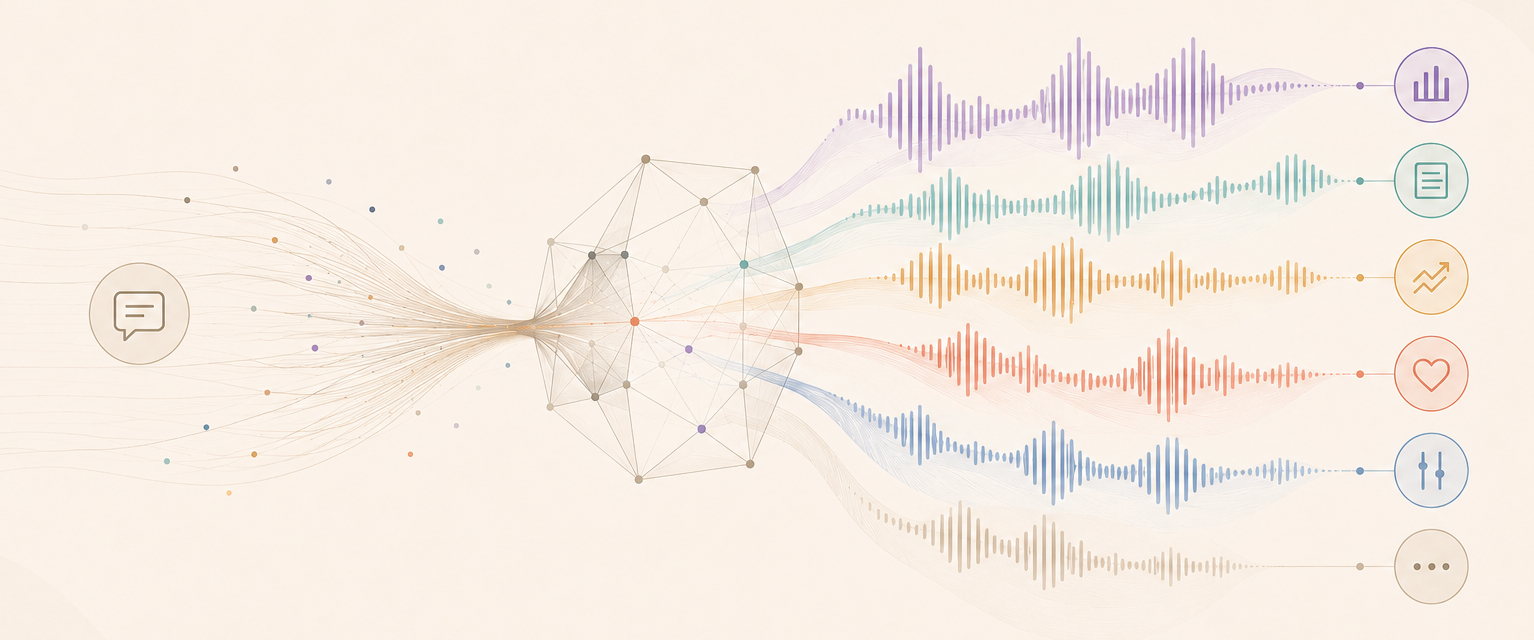
To investigate, a single sentence was run through 14 open-source text-to-speech (TTS) models over several weeks, benchmarked each of them against AWS Nova Sonic v2 as a production reference. The takeaway is that the AI audio space is more fragmented than expected and more capable than the discourse suggests. It’s also hiding several traps that will cost you time if you don’t know where to look.
This post documents each model’s exact capability of producing emotion awareness when generating audio while also logging the difficulty in manipulating the expressiveness.
Why Emotion Is the Hard Problem in TTS #
Generating intelligible speech is largely a solved problem. Every one of the 14 models can read a sentence clearly. The gap between a demo and a deployable product is almost never intelligibility. Instead, it’s affect. Does the voice sound like it means what it says? Can it express urgency without sounding robotic? Can it laugh without sounding like a waveform artifact?
This type of nuance turns out to be a much harder architectural problem than clarity is. Clarity is a function of the acoustic model learning correct phoneme mappings, but affect requires the model to encode prosodic variation (pitch contour, timing, breathiness, vocal effort) in a way that is semantically interpretable, temporally consistent, and controllable at inference time. These are three separate requirements, and most models only satisfy one or two of them.
The result is six distinct paradigms across the fourteen models, with almost no overlap between approaches and no consensus on which is correct.
Architecture First: How These Models Are Built #
Before comparing emotion paradigms it is worth understanding what these models are at the architecture level, because the architecture determines what kinds of emotion control are even possible.
Autoregressive Language Model Backbones
Maya1, Chatterbox, and Voxtral-4B-TTS all use large language model backbones as their primary generation engine. Maya1 uses a Llama-style 3B decoder with a SNAC codec at 24kHz output. Chatterbox uses a 0.5B Llama backbone. Voxtral decomposes into three learned components: a 3.4B Ministral-3B transformer decoder, a 390M flow-matching acoustic transformer, and a 300M symmetric neural audio codec.
The implication for emotion control is significant. Autoregressive LM backbones generate tokens sequentially and are sensitive to the full preceding context, including any emotion tags in the input text. This is why inline tag injection works so naturally on these architectures. The tags are just more input tokens; the model has been trained to condition its audio token predictions on them in the same way it conditions on any other semantic content.
Flow-Matching and Diffusion Decoders
VibeVoice-Realtime-0.5B uses a diffusion-based decoding approach on top of an acoustic tokenizer with 3200× downsampling. CosyVoice 3 uses a flow-matching decoder. Voxtral’s middle component, the 390M acoustic transformer, is also flow-matching based.
Flow-matching models learn to iteratively refine a noisy acoustic representation into a clean one, conditioned on the text and any style inputs. This gives them strong control over prosodic style but makes streaming harder: You typically need several denoising steps before audio is ready to emit. CosyVoice 3 achieves bi-streaming by interleaving text encoding and audio decoding steps, but the implementation complexity reflects the underlying difficulty.
Non-Autoregressive and Hybrid Architectures
Kokoro-82M is a StyleTTS 2 model with an ISTFTNet vocoder. StyleTTS 2 uses a diffusion-based style encoder to capture prosody independently of content, then synthesizes waveforms directly via adversarial training. The architecture is what makes Kokoro fast and natural simultaneously; the vocoder is dramatically cheaper at inference than a full autoregressive decode, and the style encoder does expressive work that the parameter count alone does not suggest.
Magpie TTS 357M uses multi-codebook prediction with a local transformer refinement step. Ming-Omni-TTS-0.5B is a unified generation model that jointly synthesizes speech, ambient sound, and music in a single channel, an architectural choice that explains both its unique ambient sound capability and its weaker base voice quality, because it’s optimizing across a much larger output space.
Full-Duplex Architecture (A Different Problem Entirely)
NVIDIA PersonaPlex and AWS Nova Sonic v2 operate on a different architectural premise from everything else in this comparison. They are dual-stream models: The encoder and decoder run simultaneously, enabling true listen-and-speak concurrency. PersonaPlex achieves a 90.8% smooth turn-taking success rate and 95.0% interruption success rate on FullDuplexBench, the only published benchmark numbers for open-model full-duplex capability.
Every other model in this set is half-duplex that generates sequentially. The application layer has to manage turn-taking, VAD, silence detection, and barge-in logic manually. This is not a minor implementation detail. It’s a fundamental architectural constraint that no amount of prompt engineering removes.
The Six Emotion Paradigms #
The biggest surprise was not any individual model’s quality, but how differently the field has conceptualized the problem of emotion control. These are not interchangeable design choices. They encode fundamentally different assumptions about where in a pipeline emotion should be decided, represented, and executed.
1. Inline Tag Injection
Models: AWS Nova Sonic v2, CosyVoice 3, Maya1
Emotion tags are inserted directly into the text string: [laugh],
[sigh], <whisper>, <cry>,
<gasp>. The upstream LLM decides when and where to place them; the TTS
model conditions its generation on them.
This is the most composable architecture for agentic pipelines. The LLM becomes the emotion director with zero additional infrastructure. Its output is already the input to TTS, tags included. Nova Sonic v2 was designed precisely for this pattern: a language model upstream makes all expressive decisions, and the voice model executes them faithfully.
Maya1 extends the paradigm with 20+ tags covering <giggle>,
<chuckle>, <sigh>, <gasp> alongside
the expected <laugh> and <whisper>. It also supports
natural language zero-shot voice descriptions. You can specify a voice entirely in prose
rather than selecting from a catalog, which opens up character voice design at a level that
no other open model matches.
The limitation: Tags must be placed before generation. You cannot change
the emotional direction of a sentence mid-generation. If the LLM places a
<laugh> and the audio is already streaming, you cannot retract it.
2. Parenthetical Markers
Models: fishspeech S1 mini
49 tags: (laughing), (sobbing), (whispering),
(angry), (sad), (excited), (proud),
(disgusted), (panting), (groaning) and 39 more. The
largest expressive vocabulary in this entire set by a factor of two.
The implementation mechanism is similar to inline injection but the annotation syntax differs and the vocabulary is richer. fishspeech was trained on 2M+ hours of data across 13 languages with online RLHF and achieved strong intelligibility metrics: WER of 0.011, CER of 0.005. On paper, this is the most expressive system available.
In practice, the base voice quality rated as the weakest of all locally-runnable models tested. This is the core problem with parenthetical markers at scale: the tag vocabulary is a ceiling, not a floor. If the model’s neutral voice is not good, none of the 49 tags will make the emotional outputs convincing. A well-delivered neutral is worth more than 49 tags on a voice that does not sound right.
3. Continuous Exaggeration Slider
Models: Chatterbox
No emotion type selection. No tags. A CFG exaggeration dial (0.0 to 1.0+) controls how intensely the model expresses the emotional content it infers from the text, combined with a Pace dial for delivery speed. The model reads the sentence, decides what emotional quality it contains, and scales that quality up or down.
This is the closest paradigm to how a voice director actually works. The direction is not “say this line angry,” it is “give me 30% more on that line.” The model handles the semantic interpretation; the engineer handles the intensity.
What makes this hard to use: There is an uncanny valley in the exaggeration range. Somewhere between 0.7 and 1.0, varying by sentence, voice, and content type, the output stops sounding like a person and starts sounding like an actor performing for an empty room. Finding the usable ceiling requires calibration per character and per content type that no documentation prepares you for. The pattern that emerged from testing: Simple, emotionally clear sentences tolerate higher exaggeration; complex or ironic sentences collapse into artifacts at values where simple sentences still sound natural.
Chatterbox is also the most interesting model for voice cloning combined with emotion control. Zero-shot voice cloning from a short reference clip, combined with the exaggeration dial, means you can clone a voice and then independently control how expressively it performs, which is a capability no other open model in this set provides cleanly.
4. Fine-Grained Parameter Control
Models: Ming-Omni-TTS-0.5B
Independent axes: rate, pitch, volume,
emotion, dialect. Each is set at inference time. Emotion accuracy
benchmarks at 76.7% on CV3-Eval. The only model in this set with a published emotion accuracy
number.
The control surface is architecturally the most complete. In a studio-quality voice design workflow, independent knobs for rate, pitch, and emotion are exactly what you want because they map directly to the dimensions a sound designer would reach for. The model also handles math expressions, chemical equations, and rate/pitch/volume/dialect in a unified generation channel alongside ambient sound and music, which is a genuinely novel architectural capability.
The problem is the base voice. In testing, Ming-Omni produced the least natural-sounding output of any model in the comparison. The unified multi-output architecture (speech + ambient + music in a single channel) appears to distribute model capacity across a much larger output space than pure TTS models, and the voice quality reflects that tradeoff. The parameter knobs are real and functional; they are operating on a voice that was already a weak starting point.
5. Voice Style Presets
Models: Voxtral-4B-TTS-2603 (Mistral AI)
Twenty named voice presets (cheerful_female, casual_male,
neutral_male, casual_female) where emotion is encoded in the
persona choice rather than in text markup. The model additionally handles neutral, happy,
and sarcastic tones contextually from the input text, without explicit selection.
This paradigm reframes the problem. Instead of asking “What emotion should this line
have?” it asks “Who is saying this line?” The affective output follows from
the character, not from the annotation. It is a casting decision, not a direction decision,
and that maps onto a different set of production workflows. A customer service voice agent
does not need [excited] tags on every happy response; it needs to be cast as a
naturally warm persona.
Hardware requirement: ≥16GB VRAM on a single GPU. Not Mac-compatible. vLLM is the recommended serving framework. Single-request latency is 70ms, but this climbs to 331ms at 16 concurrent requests and 552ms at 32, an 8× increase that matters enormously for multi-tenant deployments.
6. Built-In Contextual Emotion
Models: Qwen3-TTS
Emotion is a first-class property of the voice model itself. No explicit tagging required; the model infers appropriate affect from text semantics and delivers it without annotation. This is the highest-trust paradigm. You’re betting that the model’s interpretation of emotional content matches the intended delivery.
The practical advantage is zero engineering overhead for emotion: no tags to insert, no sliders to calibrate, no presets to select. The practical risk is that you cede control. When the model’s interpretation diverges from the intended effect (and it will), there is no lever to correct it short of rewriting the input text.
Does Scale Actually Help? #
This is the question that the data answers most clearly, and the answer is no, not in the way conventional ML intuition suggests.
| Model | Params | Training Data | Naturalness Result |
|---|---|---|---|
| Kokoro-82M | 82M | < few hundred hours | Very natural, surprising |
| Magpie TTS | 357M | 50,000 hours | Very natural, surprising |
| VibeVoice | 0.5B | Not disclosed | Almost the same feel as Nova Sonic v2 |
| Chatterbox | 0.5B | 500,000 hours | Very natural when tuned correctly |
| CSM-1B | 1B | Not disclosed | Sounds great |
| fishspeech S1 mini | 0.5B | 2,000,000+ hours | Sounds funny |
| DiVA | 8B | CommonVoice | Robotic |
DiVA at 8B parameters is the most computationally expensive locally-runnable model in this set and produces the worst output. fishspeech trained on 40× more data than Magpie and rated significantly worse. Kokoro-82M was trained on a few hundred hours for roughly $1,000 of compute and rated alongside models trained on orders of magnitude more data and cost.
The differentiator is architecture and data curation, not scale. Kokoro’s training data was hand-selected from CC-licensed and public domain sources. Magpie used well-documented, curated multilingual datasets. fishspeech used a large but unlabeled proprietary corpus. StyleTTS 2’s style encoder extracts prosodic features that the raw parameter count of an 82M model does not suggest it could capture. The architecture does efficiently what larger models achieve by brute force.
The secondary finding: Magpie achieves CER of 0.34% on LibriTTS test-clean with a fully disclosed, reproducible training set. That is a state-of-the-art result on an open model under 400M parameters. Scaling laws in TTS are not what they are in language modeling.
Hardware Reality: What Actually Runs Where #
This matters more than most model cards acknowledge.
| Model | Mac (MPS/CPU) | GPU Required | VRAM | Latency |
|---|---|---|---|---|
| Kokoro-82M | Yes, blazing fast | No | Minimal | Unquantified (very fast) |
| Magpie TTS 357M | Yes | No | Minimal | Unquantified (very fast) |
| VibeVoice-0.5B | Yes | No | Low | ~300ms |
| Chatterbox | Yes | No | Low | <200ms |
| Maya1 | Yes (MPS/CPU) | No | Low | Sub-100ms (vLLM) |
| Ming-Omni-TTS | Yes | No | Low | Not Specified |
| CSM-1B | Yes, slow | No | Medium | Slow |
| Dia-2B | Yes | No | Medium | Starts early |
| Voxtral-4B-TTS | No | Yes (≥16GB VRAM) | ≥16GB | 70ms single / 552ms @32 |
| CosyVoice 3 | Tedious | Yes preferred | Medium | ~150ms |
| fishspeech S1 mini | Extremely slow | Yes (CUDA) | Medium | Very slow on Mac |
| DiVA | Very difficult | Yes preferred | High | Not specified |
| PersonaPlex | No | Yes (NVIDIA) | High | 170ms / 240ms |
The practical split is: Maya1, Kokoro, Magpie, VibeVoice, and Chatterbox run well on Mac and represent the realistic local-first stack. Everything else requires infrastructure investment, and some (Voxtral, PersonaPlex, fishspeech) require it as a hard prerequisite.
For Mac-first development workflows, the local-capable tier is surprisingly strong. Maya1 at sub-100ms with ElevenLabs-level quality sets a bar that would have been considered cloud-only two years ago.
Production Gotchas #
Latency benchmarks lie at single concurrency. Voxtral’s 70ms climbs to 552ms under 32 concurrent requests. That is not a linear degradation. It reflects contention on the flow-matching acoustic transformer, which is the compute-intensive middle component. If you are benchmarking for a production decision, test at your expected p95 concurrency, not at one.
Watermarking is absent almost everywhere. 12 of 14 open models ship with no audio provenance mechanism. Only VibeVoice (dual: imperceptible digital + audible disclaimer) and Chatterbox (Perth watermarking; survives MP3 compression, audio editing, and mixing) provide attribution for generated audio. As regulatory frameworks for synthetic media mature, this gap will go from optional to mandatory. Building on a model with no watermarking now means retrofitting later.
Two models are non-commercial, and HuggingFace does not make this obvious. fishspeech S1 mini is CC-BY-NC-SA-4.0. Voxtral-4B-TTS is CC BY-NC 4.0, notable given Mistral’s general track record of Apache/MIT licensing on their language models. Both appear in search results alongside permissively-licensed models with no visual differentiation. Read the license before building any pipeline dependency.
Chatterbox’s exaggeration slider has no safe default. The documentation suggests 0.5 as a starting point. Testing showed that 0.5 is too low for expressive content and too high for matter-of-fact sentences. The usable range is narrower than the dial suggests and varies by content type. Plan for calibration time.
CosyVoice 3 is architecturally compelling and operationally painful. Cross-lingual zero-shot voice cloning at 77.4 to 78% speaker similarity (clone an English speaker and generate German in their voice) is the most powerful capability in this entire comparison. The implementation complexity on Mac is high enough that testing was abandoned. If you want CosyVoice 3 in production, budget for a Linux GPU server and a non-trivial setup investment.
Missing Pieces #
The most important capability that does not exist in any of these models is continuous real-time emotion modulation during streaming generation. Every system here requires the emotional direction to be decided before or during text generation in the prompt, the tags, the preset selection, the exaggeration value. Once audio generation starts, the emotional character of the output is fixed.
What does not exist is a model that can shift its affective tone mid-stream in response to live conversational context, the way a human naturally modulates when they hear a laugh in the middle of a sentence and shift register accordingly. This is the architectural gap that separates current TTS from genuinely conversational speech synthesis. It requires a feedback loop between the audio decoder and the semantic context at generation time, not just at prompt time.
The inline tag injection models (Maya1, CosyVoice 3) come closest because the LLM can insert tags mid-output before the full sentence is generated if the streaming architecture supports token-level handoff from LLM to TTS. But even this is a latency hack, not a true solution.
The full-duplex models (Nova Sonic v2, PersonaPlex) are the only ones where the architecture makes real-time modulation possible in principle. They are not doing it yet either, but they’re the only systems where the encoder and decoder are running simultaneously, which is the prerequisite for building it.
Emotion Expressiveness #
Eight of the fourteen models support explicit emotion control, each using one of the paradigms above. The same nine emotion categories were run through all eight from a single charged sentence: "I can't believe you actually did that. I've been waiting for this moment for years." Play any cell to hear it; only one clip plays at a time.
| Emotion | AWS Nova Sonic v2Inline tags [laugh] | Qwen3-TTSBuilt-in | ChatterboxExaggeration slider | fishspeech S1 miniParenthetical | Ming-Omni-TTSemotion= param | Maya1Inline tags <laugh> | Voxtral-4B-TTSVoice style presets | Magpie TTS 357MInline tags [angry] |
|---|---|---|---|---|---|---|---|---|
| Angry | 0:00 | 0:00 | 0:00 | 0:00 | 0:00 | 0:00 | 0:00 | 0:00 |
| Breath | 0:00 | 0:00 | 0:00 | – | 0:00 | – | 0:00 | 0:00 |
| Excited | 0:00 | 0:00 | 0:00 | 0:00 | 0:00 | 0:00 | – | 0:00 |
| Fearful | 0:00 | 0:00 | 0:00 | 0:00 | 0:00 | 0:00 | 0:00 | 0:00 |
| Laugh | 0:00 | 0:00 | 0:00 | 0:00 | 0:00 | 0:00 | 0:00 | 0:00 |
| Sad | 0:00 | 0:00 | 0:00 | 0:00 | 0:00 | 0:00 | 0:00 | 0:00 |
| Sigh | 0:00 | 0:00 | 0:00 | 0:00 | 0:00 | 0:00 | 0:00 | 0:00 |
| Surprised | 0:00 | 0:00 | 0:00 | 0:00 | 0:00 | 0:00 | 0:00 | 0:00 |
| Whisper | 0:00 | 0:00 | 0:00 | 0:00 | 0:00 | 0:00 | 0:00 | 0:00 |
The True State of the AI Audio Space #
The gap between open-source TTS and production cloud systems is narrower on naturalness than most engineers assume, and wider on infrastructure than most engineers plan for.
VibeVoice at 0.5B parameters running on a local Mac was rated as nearly equivalent to Nova Sonic v2 in naturalness. Kokoro-82M trained for roughly $1,000 of compute produced output competitive with models trained at orders of magnitude higher cost. Maya1 running on MPS/CPU at sub-100ms was rated at ElevenLabs quality. These are not consolation prizes.
Emotion control is where the fragmentation hurts. There is no common benchmark, no consensus paradigm, and no single model that combines voice quality, expressive range, production-grade latency, and a permissive license. The inline tag injection models are the most composable. Chatterbox’s slider is the most director-friendly. Voxtral’s presets are the most persona-driven. Qwen3’s contextual approach has the lowest engineering overhead. None of them does everything.
The question worth asking before selecting a model is not “Which model is best?” It’s “Where does emotion get decided in my pipeline?”
If emotion decisions come from an LLM upstream, inline tag injection is the natural fit. If emotion is determined by casting (by choosing a voice persona), Voxtral’s preset model is more appropriate. If you need studio-level control over individual expressive dimensions, Ming-Omni’s parameter surface is the right direction even if the current base voice is a limitation.
The architecture sets the control surface, which in turn shapes the production workflow. Getting that mapping right before committing to a model saves a lot of refactoring later.
Citation #
If you find this work useful, please cite:
@misc{shaqiri2026tts,
  title        = {Pushing Open-Source TTS Models to Their Limits: Six Paradigms, 14 Models, One Production Reality Check},
  author       = {Shaqiri, Ervin and Domingues, Alexandre},
  year         = {2026},
  month        = jul,
  howpublished = {Loka blog post},
  url          = {https://lokahq.github.io/tts_models_benchmark_blog/}
}
References #
- DiVA. diva-audio.github.io
- fishaudio/s1-mini · Hugging Face. Hugging Face, 6 February 2026. huggingface.co/fishaudio/s1-mini
- FunAudioLLM/Fun-CosyVoice3-0.5B-2512 · Hugging Face. Hugging Face, 23 May 2025. huggingface.co/FunAudioLLM/Fun-CosyVoice3-0.5B-2512
- hexgrad/Kokoro-82M · Hugging Face. Hugging Face. huggingface.co/hexgrad/Kokoro-82M
- inclusionAI/Ming-omni-tts-0.5B · Hugging Face. Hugging Face, 21 April 2026. huggingface.co/inclusionAI/Ming-omni-tts-0.5B
- maya-research/maya1 · Hugging Face. Hugging Face. huggingface.co/maya-research/maya1
- microsoft/VibeVoice-Realtime-0.5B · Hugging Face. Hugging Face. huggingface.co/microsoft/VibeVoice-Realtime-0.5B
- mistralai/Voxtral-4B-TTS-2603 · Hugging Face. Hugging Face, 26 March 2026. huggingface.co/mistralai/Voxtral-4B-TTS-2603
- nari-labs/Dia2-2B · Hugging Face. Hugging Face. huggingface.co/nari-labs/Dia2-2B
- nvidia/magpie_tts_multilingual_357m · Hugging Face. Hugging Face. huggingface.co/nvidia/magpie_tts_multilingual_357m
- nvidia/personaplex-7b-v1 · Hugging Face. Hugging Face, 15 January 2026. huggingface.co/nvidia/personaplex-7b-v1
- Poccia, Danilo (2025). Introducing Amazon Nova 2 Sonic: our new speech-to-speech model for conversational AI. AWS. aws.amazon.com
- Qwen/Qwen3-TTS-12Hz-1.7B-CustomVoice · Hugging Face. Hugging Face, 22 January 2026. huggingface.co/Qwen/Qwen3-TTS-12Hz-1.7B-CustomVoice
- ResembleAI/chatterbox · Hugging Face. Hugging Face. huggingface.co/ResembleAI/chatterbox
- sesame/csm-1b · Hugging Face. Hugging Face, 13 March 2025. huggingface.co/sesame/csm-1b